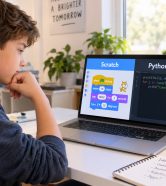

Benefits of Coding for Kids: 12 Skills Children Can Develop Beyond Writing Code
When parents hear the phrase “coding for kids,” one of the first questions may be:
Do I want my child to become a programmer in the future?
But that question only captures part of the value.
A child who learns coding is not only learning how to give instructions to a computer.
While building a game, programming a robot, designing an app, or creating a digital project, children face questions such as:
What do I want to happen?
How can I break this idea into smaller steps?
Why did the project not work the way I expected?
Which part should I change?
Is there a simpler solution?
This is where many of the most important benefits of coding for kids appear.
Coding can give children repeated opportunities to practice logical thinking, problem-solving, creativity, experimentation, persistence, and turning ideas into working projects.
And these skills are not limited to the computer screen.
Children are practicing a way of thinking that can be useful in many areas of learning and life.
However, it is important to be realistic.
Coding does not automatically make a child smarter simply because they enrolled in a course.
It does not guarantee a future career.
And it is not a solution to every educational challenge.
The real value appears when children learn through age-appropriate practical projects, where they are encouraged to think, experiment, make mistakes, and solve problems instead of simply copying code.
In this guide, we will explore 12 important benefits of learning coding for children, how each skill appears during real projects, and how parents can tell whether their child is actually developing.
Quick Answer: What Are the Main Benefits of Coding for Kids?
A well-designed coding experience can help children practice:
- Logical thinking
- Problem-solving
- Computational thinking
- Creativity
- Patience and persistence
- A healthier attitude toward mistakes
- Focus and attention to detail
- Breaking large problems into smaller steps
- Independent learning
- Confidence through real achievement
- Digital literacy and understanding technology
- Future-ready technology skills
But these benefits do not come from watching lessons alone.
They come from a cycle such as:
Idea → Attempt → Problem → Thinking → Adjustment → Testing → Working Project
Coding Benefits at a Glance
| Skill | What the Child Does During Coding | What Parents May Notice |
|---|---|---|
| Logical Thinking | Organizes instructions and decisions | Explains solutions in clearer steps |
| Problem-Solving | Searches for the cause of errors | Tries more than one solution |
| Computational Thinking | Breaks projects into smaller parts | Handles large tasks more systematically |
| Creativity | Designs games and projects | Adds original ideas |
| Persistence | Tries again after failure | Becomes less discouraged by mistakes |
| Focus | Tracks small project details | Notices small changes that affect results |
| Independence | Tests and searches independently | Needs less help over time |
| Confidence | Builds something that works | Becomes more comfortable presenting work |
| Digital Literacy | Understands how software works | Thinks more critically about technology |
| Future Skills | Explores technical fields | Discovers areas of interest earlier |
1. Coding Helps Develop Logical Thinking
One of the most important benefits of programming is that it encourages children to think in terms of:
Cause and effect.
Imagine a child building a simple game.
They want the character to jump when a button is pressed.
The logic becomes:
If X happens → Y should happen.
Then they want the player to lose a point after touching an enemy:
If the player touches the enemy → subtract one point.
Then:
If the score reaches zero → end the game.
The child is not simply memorizing information.
They are building logical relationships between actions and results.
As projects become more advanced, these relationships become more complex.
A Practical Example
A child is creating a racing game.
They do not want the car to move before the countdown finishes.
They need to think:
- Start the countdown.
- Wait until it reaches zero.
- Enable the controls.
- Allow the car to move.
If those instructions happen in the wrong order, the game may not work correctly.
That is a practical lesson in logical sequencing.
2. Coding Builds Problem-Solving Skills
Problem-solving is one of the clearest skills children practice while coding.
Programming naturally includes many small problems.
A child writes an instruction.
They expect one result.
Something different happens.
What should they do?
A computer cannot respond to:
“You know what I meant.”
The child needs to investigate.
That process can look like:
Observe → Identify → Form a hypothesis → Test → Check → Adjust
Example
A child creates a game, but the score increases twice instead of once.
Instead of immediately giving them the answer, an instructor might ask:
When does the score increase?
Is the same instruction running in two places?
What happens if we remove this block?
The error itself becomes part of the lesson.
3. Coding Develops Computational Thinking
Computational thinking is not about thinking like a machine.
It is a structured approach to solving problems.
It includes ideas such as:
Decomposition
Breaking a large problem into smaller parts.
Pattern Recognition
Identifying repeated or similar structures.
Abstraction
Focusing on the most important information.
Algorithms
Creating a clear sequence of steps to reach a result.
A Simple Example
Instead of saying:
I want to build a football game.
The child begins to break it down:
- Player
- Ball
- Goal
- Movement
- Scoring
- Timer
- Winning
- Losing
A large project has become a collection of smaller problems.
That way of thinking can be useful far beyond coding.
4. Coding Encourages Creativity
A large part of children’s technology use involves consumption:
- watching videos,
- playing games,
- using apps,
- browsing content.
Coding can change the question to:
What could I create myself?
Children can create:
- games,
- interactive stories,
- animations,
- apps,
- websites,
- robots,
- 3D models,
- electronics projects,
- AI experiments.
Creativity in Coding Is More Than Visual Design
Creativity may also mean asking:
How can I make this game different?
or:
What if the robot behaved another way?
or:
Can I solve this using fewer instructions?
Programming gives children tools for turning imagination into something that can be tested and experienced.
5. Coding Teaches Patience and Persistence
A coding project rarely works perfectly the first time.
That is normal.
A child may spend several minutes looking for:
- a block placed in the wrong location,
- a missing condition,
- an incorrect variable,
- a disconnected instruction,
- the wrong value.
Then they find the problem.
That moment matters.
The child has experienced:
I had a problem, kept working on it, and solved it.
Memorization vs Persistence
In some learning environments, a mistake simply means:
Wrong answer.
In coding, a mistake can become:
New information that helps us get closer to the solution.
That is a different learning mindset.
6. Coding Can Help Children See Mistakes Differently
One of the central ideas in programming is:
Debugging
Debugging means finding problems in a program and trying to fix them.
This can help children reframe mistakes.
Instead of:
I made a mistake, so I am bad at this.
the thinking becomes:
The result is different from what I expected. Let me find out why.
The mistake becomes a problem to investigate rather than a judgment about the child.
Useful Questions for Parents and Instructors
Instead of saying:
No, that’s wrong.
Try asking:
- What did you expect to happen?
- What actually happened?
- When did the problem begin?
- Which part could we test separately?
- What changed since the last time it worked?
These questions encourage thinking rather than dependence on answers.
7. Coding Encourages Focus and Attention to Detail
Programming depends on details.
A project may behave completely differently because a child:
- placed an instruction inside a loop instead of outside it,
- used the wrong variable,
- changed a condition,
- forgot an event,
- entered 10 instead of 100.
Children begin to understand that small details can have large effects.
But focus should not mean forcing a child to stare at a screen for hours.
A good coding project gives the child a clear objective they want to achieve.
When they genuinely want the game or robot to work, they have a reason to pay attention.
8. Coding Teaches Children to Break Big Tasks Into Smaller Ones
Imagine a child wants to create an app.
At first, the project may seem huge.
Programming teaches them not to solve everything at once.
For example:
A Simple To-Do App
The project can be divided into:
- Create the main screen.
- Add a button.
- Let the user type a task.
- Save the task.
- Display the list.
- Mark a task as completed.
- Delete a task.
This is called:
Decomposition
Why Is This Important?
Large tasks can feel overwhelming.
But when:
One large task = several smaller tasks
the problem becomes easier to approach.
9. Coding Can Encourage Independent Learning
At the beginning, children may depend heavily on an instructor.
But good learning should gradually reduce that dependence.
Instead of always asking:
What should I do next?
children begin to:
- test an idea,
- check their project,
- experiment with a command,
- review an earlier project,
- read an error message,
- compare the result with what they expected.
Growing independence is one of the strongest signs of progress.
Do Not Give the Answer Too Quickly
If a child can find the solution after another two minutes of thinking, giving them the answer immediately may remove one of the most valuable parts of the experience.
The goal is not to finish the project as quickly as possible.
The goal is to help the child become better at finding solutions independently.
10. Coding Can Build Confidence Through Real Achievement
There is a difference between telling a child:
You are smart.
and having them open a game they created and say:
I made this.
Confidence built through real achievement can be powerful.
The child has visible evidence:
- the game works,
- the robot moves,
- the website loads,
- the model has been designed,
- the app responds.
A Better Question After a Project
Do not only say:
Nice work.
Ask:
Can you explain how you made it?
When children explain:
- what they built,
- the problem they faced,
- how they solved it,
- what they added themselves,
they review their own learning and develop a stronger sense of ownership.
11. Coding Develops Digital Literacy
Children today use technology constantly.
But using technology does not necessarily mean understanding it.
There is a difference between a child who knows:
how to use an app
and a child who begins to understand:
- apps are programmed,
- data can be stored,
- algorithms follow rules,
- AI is not magic,
- software can make mistakes,
- technology is designed by people.
Technology becomes less of a mysterious black box.
Why Is This Important in the Age of AI?
Because children need more than knowing:
How do I use AI?
They also need to understand:
- When should I trust an AI result?
- How can I verify it?
- What personal information should I avoid sharing?
- Why can AI make mistakes?
- How can I use AI as a tool without allowing it to replace my thinking?
Technical foundations can help children develop a healthier relationship with emerging technologies.
12. Coding Opens the Door to Different Future Skills and Fields
Learning programming basics does not mean a child must become a software developer.
Coding can become a gateway to many areas, including:
- Robotics
- Artificial Intelligence
- Game Development
- App Development
- Web Development
- Electronics
- 3D Design
- 3D Printing
- Engineering
- Data
- Product Design
Programming can become an exploration tool.
Children begin with basic concepts, then gradually discover:
What do I want to learn more about?
Want to Know Which Benefits Your Child Will Actually Experience? Let Them Try
You can read about all the benefits of coding, but there is still one question an article cannot answer:
How will your own child respond?
One child may love games.
Another may prefer robotics.
Another may be fascinated by 3D design.
Another may enjoy solving logic problems.
If your child is between 7 and 13 years old and you live in Riyadh, you can begin with a trial session at CIY Club instead of choosing a path by guessing.
During the session, your child can:
- complete a practical activity,
- experience programming logic,
- explore a technology path,
- interact with an instructor,
- show how they approach problems,
- get a better idea of the right starting level.
You do not need to decide today that coding is the right path.
Let your child try it and observe how they think and respond.
Book a Trial Session at CIY Club
Does Coding Make Children Smarter?
This is a common claim online, but it is not the best way to understand coding education.
It is more accurate to say that good coding activities provide repeated opportunities to practice skills such as logic, problem-solving, planning, creativity, and persistence.
The actual outcome depends on factors such as:
- quality of instruction,
- age appropriateness,
- amount of practical work,
- instructor support,
- challenge level,
- consistency,
- project quality.
Do not look for exaggerated promises.
Instead, ask:
What is the child actually doing during the lesson?
Can Coding Improve Math Skills?
Programming and mathematics overlap in many areas.
Coding projects may involve:
- numbers,
- coordinates,
- measurement,
- angles,
- logic,
- patterns,
- variables.
However, coding should not be presented as a guaranteed way to improve every child’s math grades.
A more realistic benefit is that coding can create practical situations where children use logical and mathematical concepts to solve real project problems.
For example:
When moving a character, they may work with X and Y coordinates.
When rotating a robot, they may think about angles.
When creating a game, they may work with score, time, and speed.
This can make some mathematical concepts more concrete.
Can Coding Help Children Academically?
Coding can support skills that may also be useful in school, including:
- breaking tasks into steps,
- planning,
- testing,
- reviewing,
- attention to detail,
- continuing after a challenge.
But the impact differs from one child to another.
For this reason, coding should not be chosen only because:
I want better grades.
The broader value is helping children develop a stronger approach to problems, technology, and projects.
Coding and Screen Time: Benefit or Problem?
This is an important question.
If your child already spends a lot of time on devices, adding coding may appear contradictory.
But there is a difference between two types of screen use.
Screen Consumption
The child:
- watches,
- scrolls,
- switches between videos,
- plays without creating anything.
Screen Creation
The child:
- designs,
- codes,
- solves problems,
- develops an idea,
- tests a project,
- creates a game,
- controls a robot.
Coding does not automatically make all screen time healthy.
But it can transform part of technology use from:
Consumption
into:
Learning and Creation
Balance with physical activity, sleep, reading, family interaction, and offline play still matters.
Not Every Coding Course Delivers These Benefits
This is very important.
A child can spend months in a coding course without gaining many of the benefits discussed above if the method is:
Watch the instructor → Copy the code → Finish the lesson.
If the child only copies, where is the problem-solving?
If the instructor fixes every mistake, where is the debugging?
If every project is identical, where is the creativity?
If every step is predetermined, where is the independence?
How to Choose a Coding Program That Actually Develops These Skills
Look for these elements.
1. The Child Builds
The child should be doing the work, not only the instructor.
2. There Are Real Projects
Not just isolated exercises.
3. The Child Is Asked to Think
Instead of receiving every answer immediately.
4. There Is Room for Creativity
Children should be able to change:
- visuals,
- rules,
- ideas,
- sounds,
- characters,
- game levels.
5. The Difficulty Matches the Child
Too easy creates boredom.
Too difficult creates frustration.
6. There Is a Clear Progression
What can the child do today?
What should they be able to build next?
7. There Is an Opportunity to Try Before Enrolling
A trial helps parents evaluate whether the environment suits their child.
How Can You Tell If Your Child Is Really Benefiting From Coding?
Do not wait until the final certificate.
Look for these signs during the learning process.
Your Child Starts Asking:
“What if…?”
That is creativity.
They Try Again After the Project Fails
That is persistence.
They Begin Breaking Projects Into Parts
That is analytical thinking.
They Search for the Error Instead of Waiting for the Instructor
That is problem-solving.
They Modify the Project and Add Their Own Ideas
That is ownership and creativity.
They Can Explain How Their Project Works
That indicates understanding.
They Reuse an Earlier Concept in a New Project
That is a strong sign of real learning.
A 10-Question Parent Checklist
After several sessions, ask yourself:
- Can my child explain what they learned?
- Have they built something themselves?
- Did they make any design or logic choices?
- Did they face a problem and try to solve it?
- Do they understand why they used a command?
- Are they becoming less dependent on the instructor?
- Do they suggest new ideas?
- Can they modify an older project?
- Do they want to show their work to others?
- Are they excited about the next project?
If you answer yes to most of these questions, these indicators may be more meaningful than the number of lessons completed.
Coding Benefits Based on Your Child’s Interests
The benefits may appear differently depending on what your child enjoys.
A Child Who Loves Games
Game Development can help them practice:
- logic,
- design,
- rules,
- problem-solving,
- creativity.
A Child Who Loves Building Things
Robotics and Electronics may be more engaging.
They can see code become physical movement.
A Child Who Loves Drawing
They may enjoy:
3D Design
and later:
3D Printing
where a digital idea becomes a real object.
A Child Who Loves Mobile Apps
App Development can help them ask:
How are the apps I use every day actually made?
A Child Curious About ChatGPT
AI for Kids can become an opportunity to teach not only how to use AI but also how to understand it, question it, and use it responsibly.
Is Coding Still Useful If My Child Does Not Become a Programmer?
Yes.
This may be the most important point in the entire article.
Imagine your child learns coding for several years and later decides to become:
- a doctor,
- engineer,
- designer,
- entrepreneur,
- researcher,
- architect,
- marketer,
- or works in a field that does not even exist yet.
Would the years spent learning programming have been wasted?
No.
If your child becomes better at:
- analyzing problems,
- breaking tasks into smaller parts,
- experimenting,
- identifying errors,
- using technology,
- turning ideas into projects,
then coding has provided value beyond a job title.
What Can Kids Learn at CIY Club?
At CIY Club, children aged 7 to 13 can explore a range of technology learning paths, including:
- Coding for Kids
- Robotics for Kids
- Artificial Intelligence
- Game Development
- 3D Design
- 3D Printing
- Electronics
- App Development
- Web Development
Not every child is expected to enjoy the same path.
The goal is to help each child discover a suitable starting point and explore the areas that attract their curiosity through hands-on projects.
CIY Club offers in-person learning in Riyadh through its branches in:
Qurtubah
and
Al Yasmin
From Playing Games to Building Games
A small change in language can represent a major change in thinking.
Instead of:
What game should I play today?
the child begins asking:
What game could I build?
Instead of:
How do I use this app?
they begin asking:
How was this app designed?
Instead of:
The robot moves.
they begin asking:
What instructions made it move?
These questions are one of the most valuable outcomes of technology education:
Children become curious about how things are created, not only how they are used.
Do Not Rely Only on Theoretical Benefits — Watch Your Child Experience Coding
In the end, no article can tell you for certain:
Will your child enjoy coding?
Will they prefer robotics?
Will they love game development?
Will they enjoy design?
The best way to find out is through a real experience.
If your child is 7–13 years old and you live in Riyadh, they can attend a trial session at CIY Club.
During the session, you can observe:
- their level of interest,
- how they approach a problem,
- how they interact with the instructor,
- how they follow instructions,
- their curiosity,
- how much they enjoy the project.
Then you can make a decision based on real experience.
Do not only tell your child about the benefits of coding.
Let them experience what it feels like to create something that works because of their own instructions.
Book Your Child’s Trial Session at CIY Club
Frequently Asked Questions About the Benefits of Coding for Kids
What are the main benefits of coding for kids?
A good coding experience can help children practice logical thinking, problem-solving, computational thinking, creativity, persistence, attention to detail, independent learning, and digital literacy.
Does coding make children smarter?
It is better not to treat coding as a guaranteed way to increase intelligence. Coding does, however, provide practical opportunities to practice important cognitive skills such as logic, analysis, planning, and problem-solving.
Does coding help children develop logical thinking?
Yes. Programming regularly requires children to work with sequences, conditions, events, and relationships between instructions and results.
Can coding improve creativity in children?
Yes, especially when children work on open-ended projects where they can choose characters, rules, designs, and solutions rather than simply copying the instructor.
Does programming teach problem-solving?
Problem-solving is a major part of programming. When a project does not behave as expected, children need to identify the problem, test possible solutions, and try to fix it.
Is coding useful even if my child does not become a programmer?
Yes. Skills such as computational thinking, problem-solving, breaking down tasks, persistence, and understanding technology can be useful in many different careers and learning situations.
Is coding suitable for every child?
Many children can benefit from coding concepts, but the starting point should match their age and interests. Some children prefer games, while others may enjoy robotics, design, electronics, or apps.
Does coding require strong math skills?
Children do not need to be advanced in mathematics to start learning programming. Some advanced areas require more math, but beginner coding can be learned through logic, experimentation, and practical projects.
Is coding better than playing video games?
The comparison is not that simple. A child’s interest in games can actually become an entry point into coding by helping them move from simply playing games to understanding how games are designed and built.
Does coding increase screen time?
It can increase device use if it is not balanced properly. However, there is a difference between passive screen consumption and using technology to create projects, solve problems, and learn.
What is the best way to gain the benefits of coding?
Choose an age-appropriate, project-based program where children are encouraged to think, solve problems, fix mistakes, and add their own ideas rather than simply copying instructions.
How do I know if my child is benefiting from coding classes?
Look for whether they can explain their projects, modify them, solve some problems independently, reuse concepts they learned earlier, and suggest new projects and ideas.
Conclusion: The Real Benefit Is Not the Code Itself
When children learn coding the right way, the most important thing they take home is not:
Loop
or:
Variable
or:
Python
It is the thinking process they used to reach the final project.
They:
Thought
then:
Planned
then:
Tried
then:
Made a mistake
then:
Investigated
then:
Adjusted
then:
Succeeded
That journey is what makes the benefits of coding for kids much greater than simply learning a technical language.
The goal is not to turn every child into a programmer.
The goal is to help children become better able to:
understand a problem, think of a solution, test an idea, and use technology to create something new.
And if you want to know how your child will respond to this experience, do not rely on articles alone.
If your child is between 7 and 13 years old and you live in Riyadh, start with a practical experience at CIY Club and discover the technology path that sparks their curiosity.
Book Your Child’s Trial Session and Help Them Move from Using Technology to Creating It.