

- Your cart is empty Browse Shop
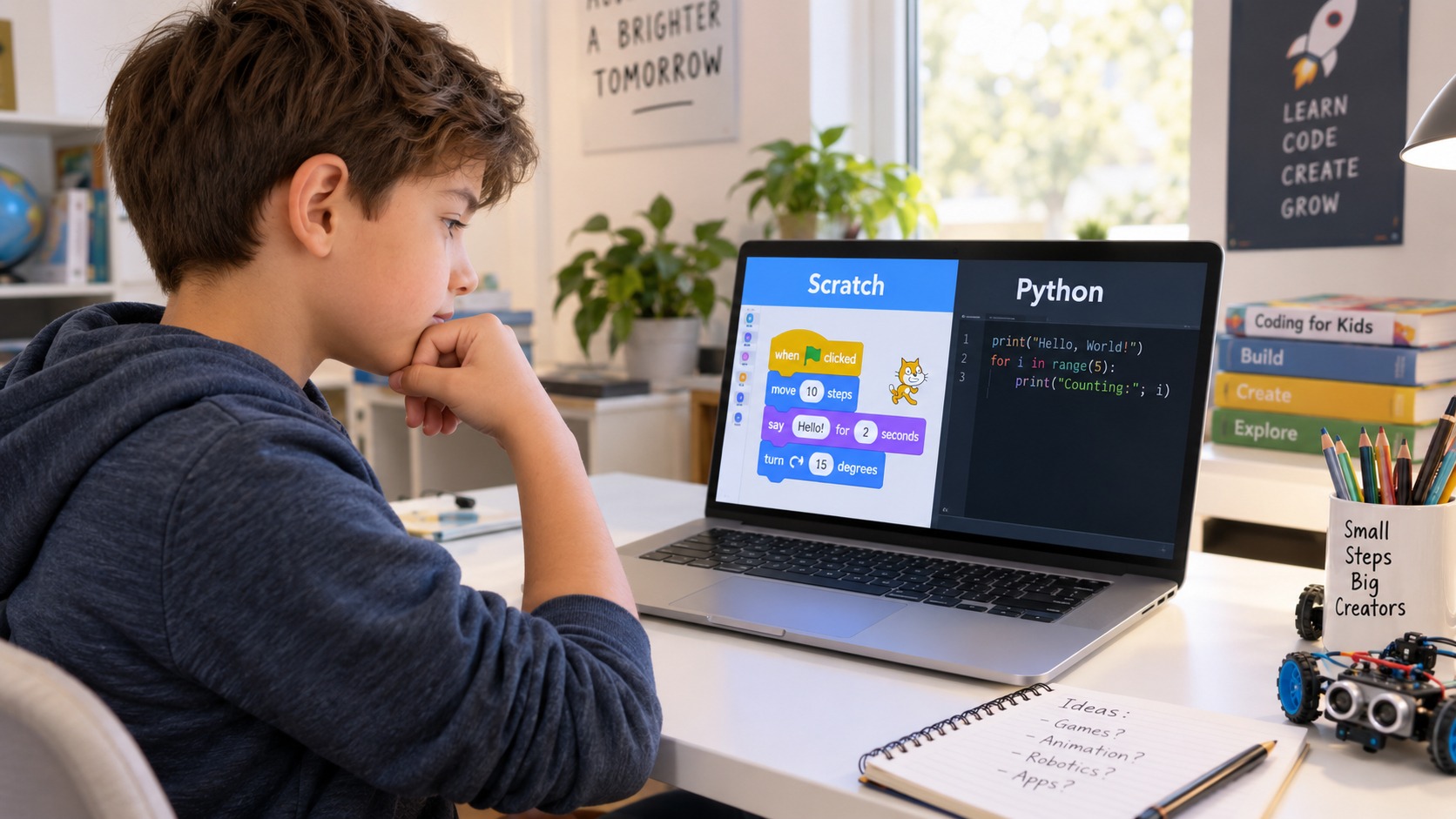
Scratch vs Python for Kids: Which Is Better for Your Child to Start With?
If you have started looking for coding classes for kids, you have probably come across two names again and again:
Scratch and Python.
And that is where many parents become confused.
Is Scratch just a simple children’s program that my child will eventually have to leave behind?
Is Python too difficult for a beginner?
Should my child start with Python immediately to avoid wasting time?
Or is it better to learn Scratch first?
Most importantly:
Which choice will help my child understand coding, enjoy learning, and want to continue?
The short answer is:
There is no universal winner between Scratch and Python. The better choice is the language that matches your child’s current level and allows them to understand programming and build projects without unnecessary technical barriers.
For many beginners, Scratch is an excellent starting point because it allows children to focus on logic and projects using visual blocks rather than worrying about typing errors.
For an older child, or one who already understands programming fundamentals and is comfortable using a keyboard, Python may be a suitable next step. Some children may even begin directly with Python when the teaching approach matches their abilities.
So the real question is not simply:
Scratch or Python?
It is:
Which one is right for my child right now?
Scratch or Python for Kids? The Quick Answer
When Is Scratch the Better Choice?
Scratch is often a good starting point if your child:
- Is completely new to coding.
- Is younger or still developing keyboard skills.
- Learns better through visual activities.
- Enjoys games, animation, and storytelling.
- Needs to see results quickly to stay motivated.
- Has not yet understood variables, loops, and conditions.
- Becomes frustrated by typing or syntax errors.
When Is Python the Better Choice?
Python may be a suitable starting point or next step if your child:
- Already understands basic programming concepts.
- Is comfortable using a computer and keyboard.
- Can read and follow short pieces of text-based code.
- Understands variables, loops, and conditions.
- Wants to explore more advanced text-based projects.
- Is interested in artificial intelligence, data, or automation.
- Is beginning to feel limited by visual programming tools.
These are guidelines, not strict rules.
A technically advanced 10-year-old may be ready for Python, while a 12-year-old who has never coded before may benefit greatly from Scratch.
Scratch vs Python for Kids: Comparison at a Glance
| Feature | Scratch | Python |
|---|---|---|
| Programming style | Visual, block-based | Text-based coding |
| Ease of starting | Very beginner-friendly | Requires more reading and typing |
| Syntax errors | Greatly reduced | A normal part of learning |
| Visual results | Usually immediate | Depends on the project |
| Suitable for complete beginners | Excellent | Possible with the right guidance |
| Games and stories | Excellent | Possible, but often requires more setup |
| Learning programming logic | Excellent | Excellent |
| Loops and conditions | Yes | Yes |
| Variables | Yes | Yes |
| Functions | Custom Blocks | Functions |
| Debugging | Visual and logical | Logical and syntax-related |
| Typing code | Not required for standard block projects | Required |
| Professional applications | Primarily an educational environment | Widely used |
| Future AI and data pathways | Limited compared with Python | Strong ecosystem |
| Speed of first project | Often faster | May require more preparation |
| Visual creativity | Built into the environment | Depends on tools and libraries |
The most important point is:
Scratch and Python do not teach completely different programming logic. Many of the core concepts are the same; the main difference is how children express those concepts.
What Is Scratch for Kids?
Scratch is a visual programming language and learning environment developed by the Lifelong Kindergarten Group at the MIT Media Lab.
Instead of typing every command, children use colorful programming pieces called Blocks and connect them together.
For example:
When the green flag is clicked
↓
Move 10 steps
↓
Repeat 10 times
↓
If touching the star, add one point
Children can see the instructions, rearrange them, and test the results immediately.
What Can Kids Create with Scratch?
Scratch can be used to create:
- Points-collection games.
- Maze games.
- Racing games.
- Quizzes.
- Interactive stories.
- Animations.
- Educational projects.
- Simple simulations.
- Platform games.
- Projects using sound.
- Interactive projects with multiple characters.
The strength of Scratch is that children can quickly create something that works, play with it, improve it, and show it to others.
Why Is Scratch Good for Beginners?
Imagine a child learning an if condition for the first time.
In Python, they may need to understand:
- What does a condition mean?
- How do I write
if? - Where does the colon go?
- What is indentation?
- Did I spell the variable correctly?
- Why am I getting a syntax error?
In Scratch, the child can first focus on the idea:
If something happens → perform an action.
Once that concept is clear, learning how to write it in Python becomes easier.
Is Scratch a Real Programming Language or Just a Game?
Scratch is a real visual programming language.
Children can build projects using concepts such as:
- Variables.
- Loops.
- Conditions.
- Events.
- Operators.
- Lists.
- Messages.
- Custom Blocks.
- Programming logic.
The problem is not Scratch itself.
The problem appears when teaching is limited to:
Put the blue block here, then the yellow block here, then press Play.
without helping the child understand why.
Does Using Blocks Make It Harder to Learn Text-Based Code Later?
Not when children are learning the concepts properly.
If a child understands:
- Why we use a loop.
- When we need a variable.
- How a condition works.
- The difference between an event and an action.
- How to break down a problem.
- How to investigate an error.
those concepts can transfer when they begin text-based programming.
What Is Python for Kids?
Python is a text-based programming language where children type instructions using a keyboard.
For example:
name = input("What is your name?")
print("Hello", name)
Or:
for i in range(5):
    print("Hello")
Unlike Scratch, children do not rely on visual blocks for standard Python programming.
They need to type:
- Keywords.
- Brackets.
- Variable names.
- Required punctuation.
- Indentation.
This introduces a new level of technical skill.
Why Is Python a Good Language for Kids to Learn?
Python is commonly used as a first text-based language because its syntax is relatively readable compared with many other programming languages.
It is also used in a wide range of fields, including:
- General programming.
- Automation.
- Data.
- Artificial intelligence.
- Machine learning.
- Software applications and services.
However:
The fact that Python is powerful and widely used professionally does not mean it is always the best first language for every child.
Why Can Python Be Harder Than Scratch at the Beginning?
Because children may face two types of challenges at the same time.
Challenge One: Understanding the Logic
For example:
How do I make the program repeat an instruction?
Challenge Two: Writing the Code Correctly
Did I type the instruction correctly?
A child may understand the idea perfectly, but the program may not run because of:
- A spelling mistake.
- A missing bracket.
- An incorrect variable name.
- A missing colon.
- Indentation.
- Another syntax error.
These are normal parts of programming, but they can distract a younger beginner from the concept they are trying to learn.
Can a Child Start Python Without Learning Scratch?
Yes.
Scratch is not a mandatory prerequisite.
A child may be able to start directly with Python if they:
- Are comfortable typing.
- Understand instructions well.
- Can handle some syntax errors without becoming overly frustrated.
- Have a clear interest in text-based programming.
- Learn through age-appropriate projects.
- Receive suitable guidance.
The Difference Between Scratch and Python in Programming Concepts
One of the most important things parents should understand is that children do not leave everything behind when they move from Scratch to Python.
The concepts move with them.
Variables
In Scratch, a child may have a variable called:
Score
In Python:
score = 0
score = score + 1
What Does the Child Learn?
The idea is the same:
A value is stored and can change while the program runs.
Conditions
In Scratch:
If Score = 10 → Say “You Win”
In Python:
if score == 10:
    print("You Win")
What Is Important Here?
The logic is the same:
Condition → Action
Only the way it is written changes.
Loops
In Scratch:
Repeat 10 times
In Python:
for i in range(10):
    print(i)
Why Does Scratch Help Here?
Because the child may already understand what repetition means before needing to learn Python syntax.
Functions and Custom Blocks
In Scratch, children can create a Custom Block for a group of instructions.
In Python:
def jump():
    print("Jump!")
What Does the Child Learn from Comparing Them?
Programming languages may change, but many fundamental ideas remain the same.
Scratch or Python: Which Is Better by Age and Experience?
Age is useful, but it is not the only factor.
Ages 7–8
For many children in this age group, Scratch is a strong starting choice, especially for beginners.
Children can learn:
- Movement.
- Events.
- Loops.
- Conditions.
- Variables.
- Simple games.
- Interactive stories.
They can do this without keyboard speed becoming a major barrier.
Ages 9–10
At this stage, the decision depends more on the child’s experience.
If the Child Is a Complete Beginner
Scratch can still be an excellent introduction.
If the Child Has Already Learned Scratch
They may be ready to begin Python gradually.
If the Child Is Comfortable with Computers, Typing, and Logic
They may be able to start directly with Python using an appropriate teaching approach.
Ages 11–13
Python becomes a strong option for many children, especially those who:
- Have previous coding experience.
- Enjoy problem-solving.
- Are comfortable typing.
- Want more advanced projects.
- Are interested in AI, data, or text-based programming.
But there is nothing wrong with using Scratch for an 11- or 12-year-old who is starting from zero.
What If My Child Is 12 and Has Never Coded Before?
I would not automatically choose Python just because the child is older.
I would first ask:
- Are they comfortable using a computer?
- How are their typing skills?
- Have they learned any programming logic before?
- Do they enjoy games?
- What would they like to create?
- How do they respond when something does not work?
A suitable plan might be:
A short Scratch introduction → Then Python
Or:
Python directly
if the child is ready.
Language Selection by Child’s Level
| Child’s Situation | Suggested Starting Point |
|---|---|
| Young and completely new to coding | Scratch |
| Loves games, stories, and animation | Scratch |
| Still developing typing skills | Scratch |
| Easily frustrated by technical errors | Scratch |
| Has solid Scratch experience | Python |
| Understands variables, loops, and conditions | Python |
| Comfortable with text-based coding | Python may be suitable |
| Older child starting from zero | Scratch or Python after assessment |
| Interested in future AI studies | Python after building foundations |
| Loves game creation | Scratch, then game development |
| Loves robotics | Block coding or Python, depending on platform and level |
How Do You Know Your Child Is Ready to Move from Scratch to Python?
Do not move your child simply because they have completed a certain number of lessons.
Look for these signs instead.
They Can Build a Simple Project Independently
For example:
- A small game.
- An interactive story.
- A quiz.
- A simple project based on their own idea.
They Understand Variables, Loops, and Conditions
They do not just know where the block is located.
They understand:
- When to use a variable.
- Why a loop is useful.
- What a condition does.
They Can Explain Their Project’s Logic
Even if they do not know every technical term.
They Try to Find and Fix Errors
Instead of waiting for the instructor to provide the answer immediately.
They Are Ready for Text-Based Coding
They can use a keyboard comfortably enough to focus on learning rather than struggling with every character.
They Want More Advanced Challenges
They may begin asking:
How do we write this without blocks?
Or they may feel that Scratch is becoming limited for some of their ideas.
That can be a good sign that they are ready for the next step.
Quick Test: Which One Suits Your Child Right Now?
Is This Your Child’s First Coding Experience?
Yes → A point in favor of Scratch.
Does Your Child Type Slowly on a Computer?
Yes → Scratch may be a better starting point.
Do They Love Games, Animation, and Stories?
Yes → Scratch may be especially engaging.
Do They Already Understand Loops, Variables, and Conditions?
Yes → Python may be getting closer.
Can They Read a Short Piece of Code and Try to Understand It?
Yes → A point in favor of Python.
Do Typing Errors Frustrate Them Quickly?
Yes → Scratch may reduce unnecessary barriers at the beginning.
Do They Specifically Want to Learn Python or AI?
That is a positive sign, but ask:
Do they have the foundations needed to understand Python, or would they simply be copying code?
What Does the Test Result Mean?
If most answers point toward:
- Being a beginner.
- Learning visually.
- Developing typing skills.
- Loving games and interactive projects.
Scratch may be the better starting point.
If your child:
- Understands the fundamentals.
- Types comfortably.
- Wants a greater challenge.
- Has previous programming experience.
Python may be the next step.
Do Not Choose by Guessing: Try a Practical Assessment
If your child is between 7 and 13 years old and you live in Riyadh, they can attend a trial session at CIY Club.
A practical activity can help reveal:
- How they think.
- How quickly they understand instructions.
- Their previous experience.
- Their computer skills.
- How they respond to mistakes.
- Their interests.
- Whether visual or text-based coding is more suitable.
Book a Trial Session for Your Child at CIY Club
How Can Kids Move from Scratch to Python Step by Step?
The transition does not have to happen suddenly.
Stage One: Strengthen the Programming Foundations
Children should understand concepts such as:
- Events.
- Loops.
- Conditions.
- Variables.
- Operators.
- Custom Blocks.
- Debugging.
Stage Two: Read and Understand Simple Python Code
Start with something like:
score = 0
Then ask:
What do you think this means?
Help the child connect it to the idea of a variable they already know.
Stage Three: Rebuild a Familiar Idea
If the child created a quiz in Scratch, build a simple version of it in Python.
This way, the new challenge is the syntax, not the entire project idea.
Stage Four: Complete Short Python Projects
Examples include:
- Greeting Program.
- Calculator.
- Number Guessing Game.
- Quiz.
- Simple Text Adventure.
Stage Five: Create a Project Based on the Child’s Own Idea
This is one of the most important stages.
Do not make every project a copy of the instructor’s example.
Ask:
What would you like to build now?
Can Kids Learn Scratch and Python at the Same Time?
They can, but it is not always the best approach for a beginner.
If the child is still trying to understand:
- Variables.
- Loops.
- Conditions.
- Events.
introducing two different ways of expressing the same concept may create unnecessary confusion.
A useful approach is:
Understand the concept in one environment → Then compare it in the second environment.
Examples of a Good First Project in Each Language
Scratch Project: Collect the Stars
The child creates a game where they control a character and collect stars.
Skills the Child Learns
- Movement.
- Events.
- Conditions.
- Variables.
- Scoring.
- Debugging.
The advantage is that the result is visual and immediate.
Python Project: Number Guessing Game
The program chooses a random number and asks the child to guess it.
Skills the Child Learns
- Input.
- Variables.
- Conditions.
- Random numbers.
- Output.
- Logic.
How Do You Choose the Right First Project?
Do not choose the project that looks the most professional.
Choose a project that:
- The child can understand.
- They can complete in a simple version.
- Matches their interests.
- Allows them to add their own ideas.
- Gives them a sense of achievement.
Which Is Better for Your Child’s Future Interests?
Scratch for Games and Interactive Stories
Scratch is excellent for visual projects such as:
- Games.
- Stories.
- Animations.
- Interactive learning projects.
Children can easily change:
- Characters.
- Backgrounds.
- Sounds.
- Movement.
- Rules.
This makes it especially engaging for children who enjoy visual creativity.
Python for Artificial Intelligence and Data
Python is more closely connected with advanced areas such as:
- Artificial Intelligence.
- Data.
- Automation.
- Text-based programming.
But that does not mean a child who is interested in AI must begin with Python on their first day, regardless of their level.
Building strong foundations comes first.
Scratch and Python in Robotics
Robotics platforms may support:
- Block coding for beginners.
- Python for more advanced levels.
A learning path could therefore look like:
Scratch / Blocks → Robotics → Python
depending on the equipment and the child’s level.
What If Your Child Loves Design or Apps?
Their journey does not have to be limited to:
Scratch → Python
It could be:
Coding → 3D Design
Or:
Coding → App Development
Or:
Coding → Electronics
Or:
Coding → Web Development
Is Python Better for the Future Than Scratch?
Python has much broader professional applications.
But that does not make time spent learning Scratch a waste.
Scratch is designed to help build programming foundations.
Think of a child learning to read using beginner books before moving on to more advanced books.
We would not say the beginner books were useless because they are not university textbooks.
The same principle applies here.
Common Mistakes When Choosing a Child’s First Programming Language
Treating Scratch as a Toy and Python as the Only Real Programming
Scratch teaches real programming concepts.
Choosing a Language Based on Its Power Instead of the Child’s Level
The most powerful tool is not always the best educational tool for a beginner.
Moving to Python Before Understanding the Fundamentals
If a child does not understand:
- Variables.
- Conditions.
- Loops.
- Logic.
they may simply move from copying Scratch blocks to copying Python code.
Keeping a Child at an Easy Level for Too Long
Scratch is excellent, but when the child is ready, the level of challenge should increase.
Comparing Your Child with Other Children
My friend’s child is nine and already writes Python.
That does not tell you what is best for your child.
Focusing on the Language Name Instead of Projects
Ask:
What can my child actually build?
Learning Two Languages at the Same Time Without a Clear Reason
This may create confusion for beginners rather than accelerate their learning.
How to Choose the Right Scratch or Python Course for Your Child
What to Look for in a Scratch Course
Ask:
- Does the child build games and projects?
- Do they understand why they use each block?
- Can they modify the project?
- Are there projects based on their own ideas?
- Do they learn debugging?
- Is there a clear next level after Scratch?
What to Look for in a Python Course
Ask:
- Is the content designed for children?
- Are the projects age-appropriate?
- Does learning begin with practical activities?
- Is logic explained before syntax becomes overwhelming?
- What will the child be able to build?
- How does the instructor handle errors?
- Does the child understand or simply copy?
- Is the course suitable for their current level?
Signs That a Course May Not Be Suitable
Pay attention if:
- The child copies throughout the lesson.
- They cannot explain their project.
- There are no meaningful projects.
- There is no room for creativity.
- Every child follows identical steps at the same pace.
- The instructor fixes every problem.
- The child feels constantly frustrated.
- The level is far beyond their ability.
- You cannot identify which skills are improving.
What Should Come After the First Level?
A possible path could be:
Logical Thinking
↓
Scratch / Visual Programming
↓
Games & Projects
↓
Advanced Programming Concepts
↓
Python
↓
AI / Games / Web / Apps / Robotics / Data
This is a flexible model, not a mandatory path for every child.
How Does CIY Club Help Your Child Choose the Right Path?
At CIY Club, children’s technology education is not limited to Scratch or Python.
Technology Learning Paths Available for Kids
Children can explore:
- Coding for Kids.
- Robotics.
- Artificial Intelligence.
- Game Development.
- 3D Design.
- 3D Printing.
- Electronics.
- App Development.
- Web Development.
Why Are Level and Interest Assessments Important?
Because two children of the same age may have very different:
- Previous experience.
- Typing skills.
- Logical thinking abilities.
- Learning styles.
- Interests.
- Responses to mistakes.
Age alone should not determine the learning path.
CIY Club Branches in Riyadh
In-person learning is available through the club’s branches in:
Qurtubah
and
Al Yasmin
Book a Trial Session for Your Child
A practical session can provide a better answer than guessing:
Does my child need Scratch right now, or are they ready for Python?
Book Your Child’s Trial Session at CIY Club
Frequently Asked Questions About Scratch and Python for Kids
Which Is Better for Kids: Scratch or Python?
There is no single best language for every child. Scratch is excellent for many beginners because it uses visual programming, while Python may be more suitable when a child is ready for text-based coding or already understands programming fundamentals.
Should My Child Start with Scratch or Python?
If your child is completely new to coding, younger, or not yet comfortable typing, Scratch may be an excellent starting point. An older or more experienced child may be able to start directly with Python.
What Is the Best Age to Learn Scratch?
Scratch is designed primarily for ages 8–16, but it is also used by people of other ages. The child’s individual readiness matters more than age alone.
What Is the Best Age for Kids to Learn Python?
There is no fixed age. Children can begin Python when they are ready for text-based programming and have sufficient understanding of programming concepts. Some children are ready around ages 9–10, while others benefit from starting later.
Is Scratch a Real Programming Language?
Yes. Scratch is a visual programming language that teaches real concepts such as variables, conditions, loops, events, and programming logic.
Is Scratch Just for Games?
No. Scratch can be used to create games, interactive stories, animations, simulations, and educational projects.
Is Python Difficult for Kids?
Python can be more challenging than Scratch at the beginning because it requires typing and syntax. However, children can learn it successfully when the teaching method and difficulty level are appropriate.
Does My Child Have to Learn Scratch Before Python?
No. Scratch is not a mandatory prerequisite, but it can help many beginners understand programming logic before moving to text-based code.
When Should My Child Move from Scratch to Python?
When they understand variables, loops, and conditions, can build simple projects, try to solve errors, and are ready to work with text-based code.
Is Learning Scratch a Waste of Time If My Child Will Use Python Later?
No. If children learn the concepts and logic rather than simply copying blocks, those skills can transfer to other programming languages.
Can Kids Learn Scratch and Python at the Same Time?
They can, but for beginners it is often better to establish the concepts in one environment before comparing them in another.
Which Is Better for Making Games?
Scratch makes it quick and easy for beginners to create visual games. Python can also be used to make games, but it usually requires more text-based programming knowledge and additional tools.
Which Is Better for AI: Scratch or Python?
Python is more closely associated with advanced AI applications, but children should first build a strong foundation in programming.
How Do I Know Which One Suits My Child?
Consider their age, level, typing skills, previous experience, interests, and how they respond to problems. A practical assessment can provide a more accurate picture than age alone.
Conclusion: Choose the Language That Suits Your Child Right Now
If we had to summarize Scratch vs Python for kids in one sentence:
Scratch helps children learn programming while reducing typing barriers, while Python allows them to express similar logic using more flexible text-based code.
For many children, a path such as:
Scratch → Understanding Logic → Projects → Python
can work extremely well.
But it is not the only path.
Another child may be ready to begin directly with Python.
A third child may discover programming through robotics or game development.
So do not make the goal:
My child must learn Python as quickly as possible.
Make the goal:
My child should build strong foundations and want to keep learning.
If your child learns Scratch while they are:
- Thinking.
- Solving problems.
- Creating.
- Experimenting.
- Investigating errors.
then they are genuinely learning programming.
And if they learn Python by only copying what the instructor types, the language name alone will not make the difference.
Start with an Assessment Instead of Guessing
The right question is not:
Which language is more powerful?
It is:
Which learning experience will help my child understand coding and want to build the next project?
If your child is between 7 and 13 years old and you live in Riyadh, you can explore the answer through a trial session at CIY Club, where their level and technology interests can help guide the next step.
Book Your Child’s Trial Session and Help Them Start with the Right Tool
